Rank & Select
Last week: Models of computation Link to heading
- Big-O notation
- Word RAM model
- Applications & limitations
Today Link to heading
- Bit vectors
- storing bits
- Rank
- counting 1-bits
- Select
- finding 1-bits
- Engineering Rank
- making it fast
- Elias-Fano coding
- storing integers efficiently
Bit vectors Link to heading
A static bit vector is an implicit data structure storing \(n\) bits \(b_0, \dots, b_{n-1}\) with constant overhead.
- \(\mathsf{get}(i)\): returns \(i\)’th bit \(b_i\)
Implemented using e.g. Vec<u64>.
| |
Little Endian: the low-order bits are first in memory.
\[ \newcommand{\rank}{\mathsf{rank}} \newcommand{\select}{\mathsf{select}} \]
Binary Rank & Select Link to heading
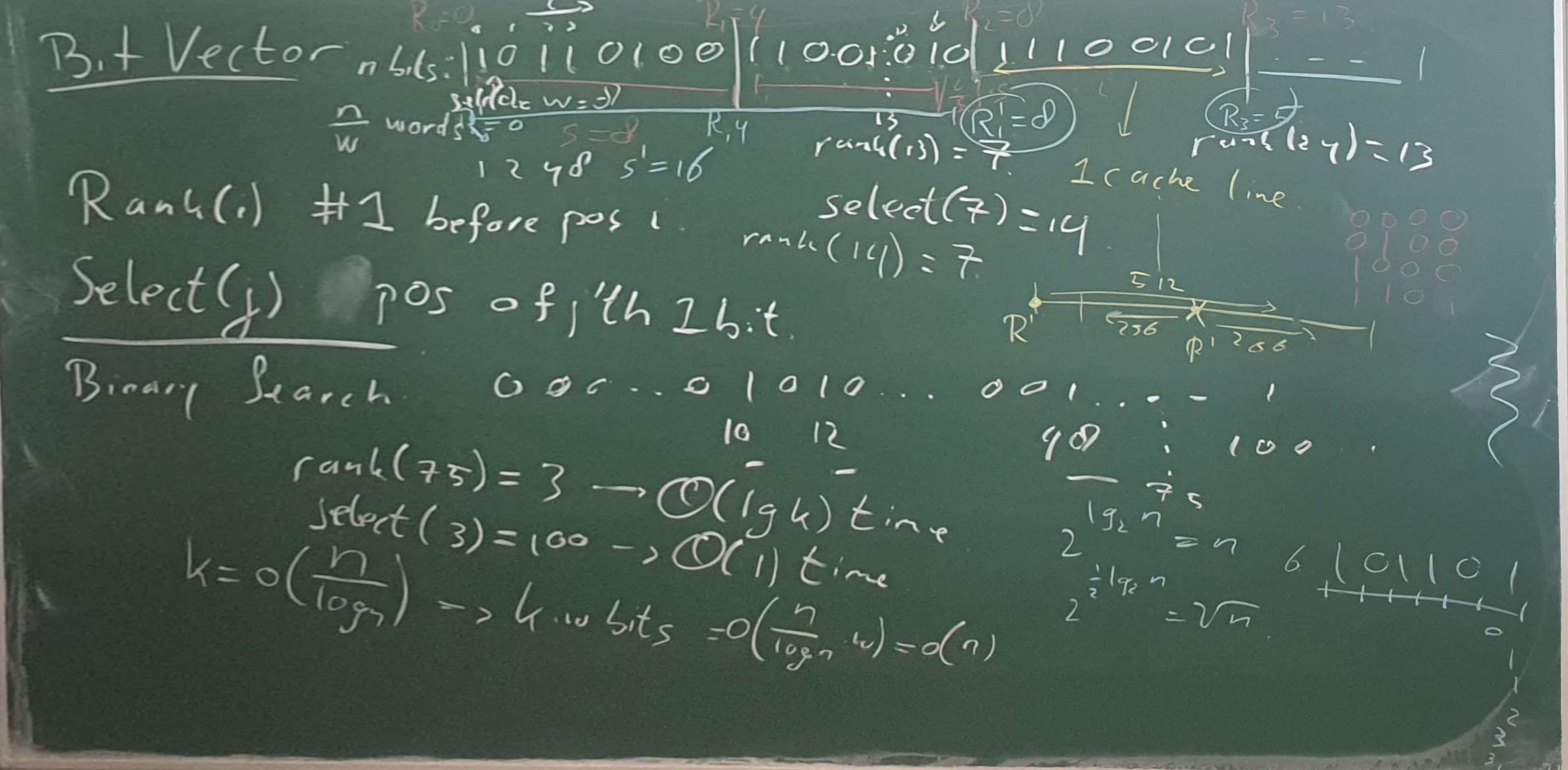
A rank query on a bit vector counts 1-bits before a position \(i\) (for \(0\leq i\leq n\)).
- \(\rank(i) := \sum_{0\leq j < i} b_j\)
A select query on a bit vector returns the position of the \(j\)’th 1 (zero-based, for \(0\leq j < \rank(n)\)).
- \(\select(j) :=\) index \(i\) such that \(b_i=1\) and \(\rank(i) = j\).
Also: \(\rank_0\) and \(\select_0\) for counting/finding 0-bits.
What is \(\rank_1(\select_1(j))\)?
And \(\select_1(\rank_1(i))\)?
\(\rank_1(\select_1(j))\) equals \(j\).
\(\select_1(\rank_1(i))\) finds the position of the first 1 at position \(\geq i\).
Binary Rank & Select: Goal Link to heading
There exists a data structure that answers rank and select queries:
- in constant \(O(1)\) time,
- using succinct \(o(n)\) bits of additional space.
Rank: first steps Link to heading
Compute the answer on-demand:
- No space overhead
- \(O(n/\log n)\) query time
- We pop-count \(w=\Theta(\log n)\) bits at a time.
Pre-compute and store all answers:
- \(n\) words overhead
- \(O(1)\) query time
Rank: Binary search Link to heading
Store positions of all 1-bits. Then binary search to get the number of them at position \(\lt i\):
- \(k\) words overhead, for \(k := \rank(n)\).
- \(O(\log k)\) query time
Rank: Checkpoints Link to heading
Store a checkpoint every \(s\) bits: \(R_k := \rank(k\cdot s)\).
- \(n/s\) words overhead
- \(O(s/\log n)\) query time: \[\rank(i) = R_{\lfloor\frac is\rfloor} + \sum_{s\lfloor\frac is\rfloor \leq j < i} b_j\]
For \(s=w = \Theta(\log n)\):
- \(n/w\) words, or \(n\) bits overhead.
- Compact, but not succinct
- \(O(1)\) queries
- Adjacent checkpoints \(R_k\) are similar!
Rank: A succinct version (Jacobson 1988) Link to heading
- Blocks of size \(s = w\).
- Super blocks of size \(s’ = w^2\).
- Store \(w\)-bit super block ranks \(R’_k := \rank(k\cdot s’)\).
- \(\lceil n/s’\rceil \cdot w = O(n/\log n) = o(n)\) bits
- Store \(\log_2 s’\)-bit block ranks relative to super block:
\[R_k = \rank(k\cdot s) - R’_{\lfloor k/w\rfloor} \leq s’.\]
- \(\lceil n/s\rceil \cdot \log_2(s’) = O(n/w \cdot \log_2 w) = o(n)\) bits
- Constant time queries: \[\rank(i) = R’_{\lfloor i/s’\rfloor} + R_{\lfloor{i/s\rfloor}} + \sum_{s\lfloor\frac is\rfloor \leq j < i} b_j\]
Rank: Emulating popcount Link to heading
- Originally, constant time \(w\)-bit popcount was not assumed.
Instead, we can take \(s = (\log_2 n)/2\), and pre-compute popcounts for all \(2^s\) masks:
- \(2^s = \sqrt{n}\) patterns
- \(s\) offsets per pattern
- \(\log_2 s\) bits per count
\[2^s \cdot s \cdot \log_2 s = O(\sqrt n \cdot \log_2 n \cdot \log_2\log_2 n) = o(n).\]
Engineering Rank: minimizing space usage Link to heading
In practice, we don’t need succinct. Compact with small constant overhead is enough. See QuadRank slides.
- \(s=512\): Store a 64-bit checkpoint every 512-bits of data:
- \(64/512 = 12.5\%\) space overhead;
- pop-counting 512 bits is sufficiently fast.
- Smaller, \(s’=2^{16}\): 16-bit checkpoints, and \(s’=2^{16}\)-bit super blocks storing 64-bit
checkpoints. (Kurpicz 2022)
- \(16/512 + 64/2^{16} = 3.2\%\) overhead.
- Faster count: checkpoints to the middle of each block: (Gottlieb and Reinert 2025)
- popcount only 256 bits.
- Fewer cache misses: store checkpoints inside each block: (Laws et al. 2024)
- 1 instead of 2 cache misses
- \(16/(512-16) + 64/2^{16} = 3.3\%\) overhead.
- Simple & fast classic: Rank 9 (Vigna 2008)
- 64-bit blocks with 9-bit checkpoints; 7 of them make a
u64.
- 64-bit blocks with 9-bit checkpoints; 7 of them make a
Select Link to heading
Assume we have \(k\) 1-bits.
- Compute all answers on-demand: \(O(n/\log n)\) queries.
- Store all answers: \(O(k)\) words.
- Sufficient if \(k = o(n / \log n)\).
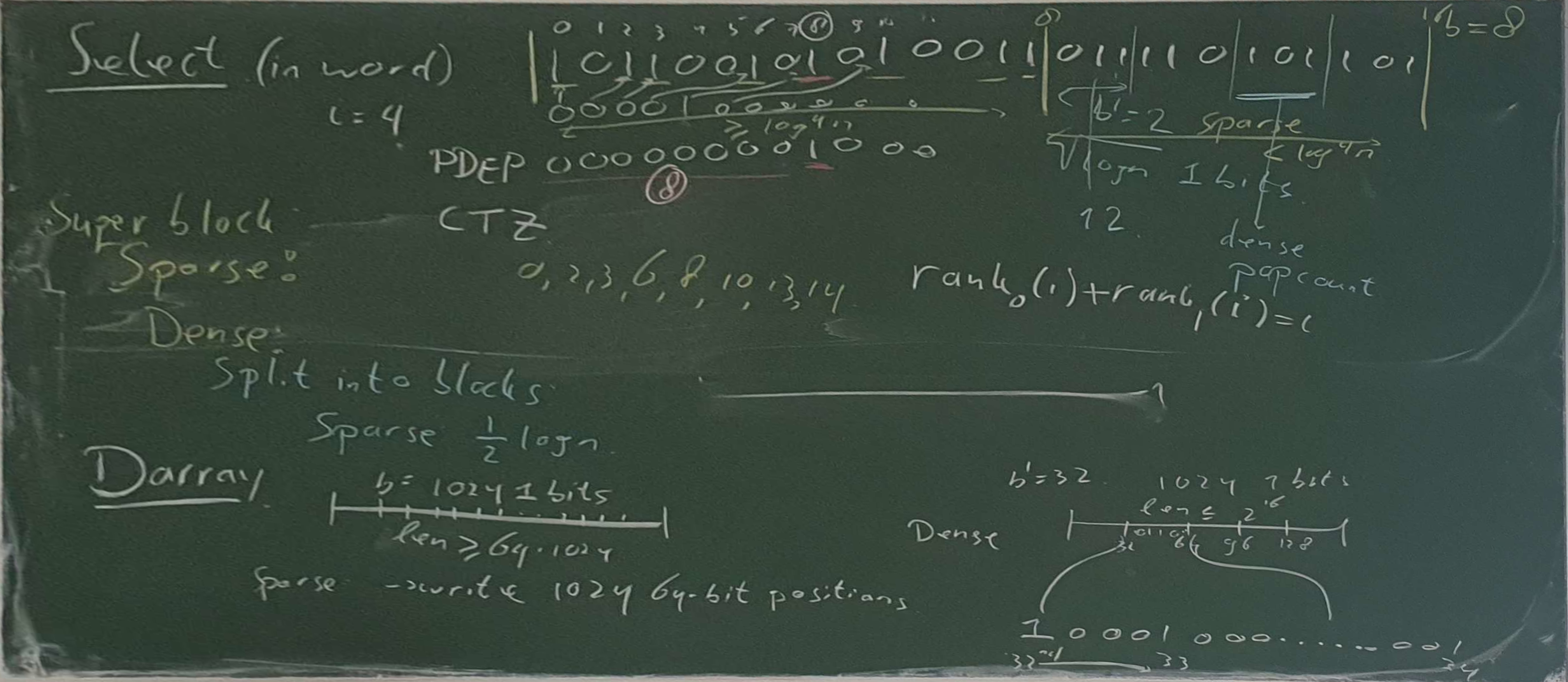
The position of \(i\)’th 1-bit in a word can be found in constant time (in the “modern” word RAM model) using
| |
which uses pdep and tzcnt instructions (wikipedia, deposit_bits).
Succinct Select (Clark and Munro 1996) Link to heading
- Variable-sized super-blocks \(B_i\) containing \(b:=\log ^2 n\) 1-bits
\[\select(i) = \left(\sum_{0\leq j < \lfloor i/b\rfloor} |B_j|\right) + \select(B_{\lfloor
i/b\rfloor}, i - b\lfloor i/b\rfloor).\]
- Prefix sums take \(n/b \cdot w = O(n/\log n) = o(n)\) bits.
- Sparse blocks with \(|B| \geq \log^4 n\):
- Store answers directly in \(bw = \Theta(\log^3n)\) bits.
- \(\log^4\) bits in block, so \(o(n)\) overall.
- Dense blocks with \(|B| < \log^4 n\): next slide
Dense blocks with \(|B| < \log^4 n\):
Split again into variable-sized blocks of \(b’=\sqrt{\log n}\) ones.
- Prefix sums take \(\log \log^4 n\) bits per element, \(O(k/b’ \cdot \log \log^4 n) = o(n)\) total
- If sparse, size \(\geq \frac 12\log n\):
- Store \(b’\) \(\log_2(\log^4 n)\)-bit numbers, \(o(\log n)\) total
- If dense, size \(<\frac 12\log n\):
- Use
select_in_word - Clark’s select stores a lookup table like for popcount.
- Use
To answer \(\select(j)\):
- Find the super block \(\lfloor j/b\rfloor\).
- If sparse: read answer.
- If dense: find block \(\lfloor j/b’ \rfloor\).
- Read offset of superblock.
- Read offset of block inside superblock.
- If sparse block: read the position relative to the block.
- If dense block: popcount inside the block.
There exists a data structure with \(o(n)\) space overhead that allows \(O(1)\) rank and select queries.
Select in practice: Darray Link to heading
- Super blocks containing \(b = 2^{10}\) ones.
- Sparse if length \(\geq 2^{16}\)
- Use \(2^6=64\) bits to encode each position; \(64\cdot 2^{10} = 2^{16}\) bits
- Dense blocks (len \(<2^{16}\)):
- Store position of every \(2^5=32\)’nd 1, relative to start (10 bits each).
- Linear scan (\(<2^{16}\)) from there to find the exact answer.
- The last sparse/dense split from Clark’s select (previous slide) is skipped.
Further reading Link to heading
- QuadRank slides and paper (Groot Koerkamp 2026)
- Ben Langmead’s teaching material on bitvectors, rank, and select.
- With YouTube videos.
Next: Elias-Fano coding Link to heading
Bibliography Link to heading
References Link to heading
Possible exam questions Link to heading
- What does a rank query return? And select? How do they relate to each other?
- What is the main technique used to obtain a succinct rank data structure? And for select?
- Name a few ways in which practical rank methods differ from the Jacobson’s theoretical version.
- How does Darray differ from Clark’s select?
- Which modern CPU instructions can be used for rank and/or select? What older techniques do they replace?
- For both rank and select, why does a single layer of blocks not suffice to obtain \(o(n)\) space and \(O(1)\) query time?
Blackboard: Bit vector & Rank Link to heading
Blackboard: Select & Darray Link to heading