A History of Pairwise Alignment
Ragnar {Groot Koerkamp}
CiE 2026, Trier
curiouscoding.nl/{posts,slides}/pairwise-alignment

My blog: curiouscoding.nl
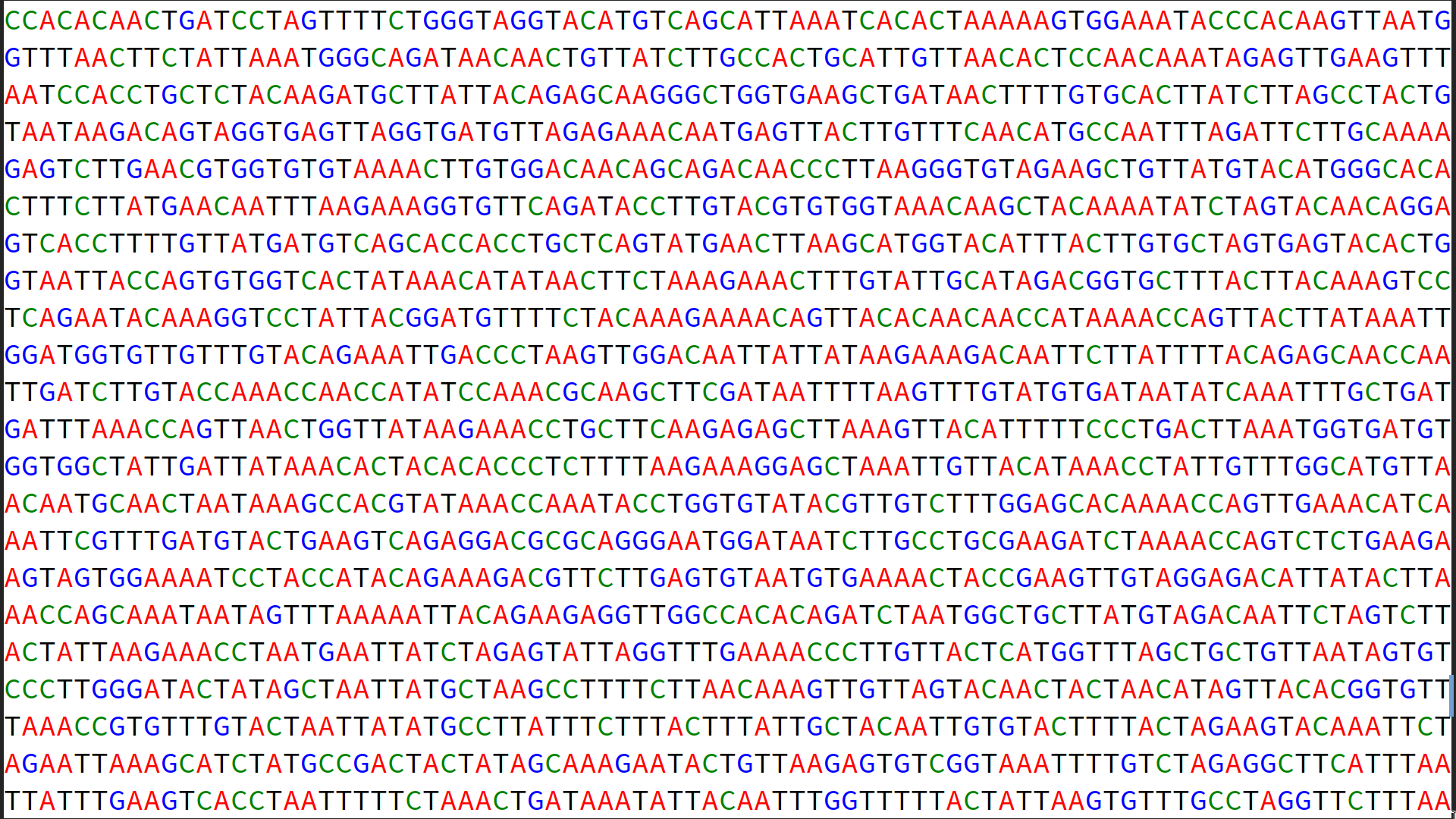
Pairwise alignment:
finding differences between strings
Covid – \(\alpha\), December 2020
Covid – \(\omicron\), December 2021
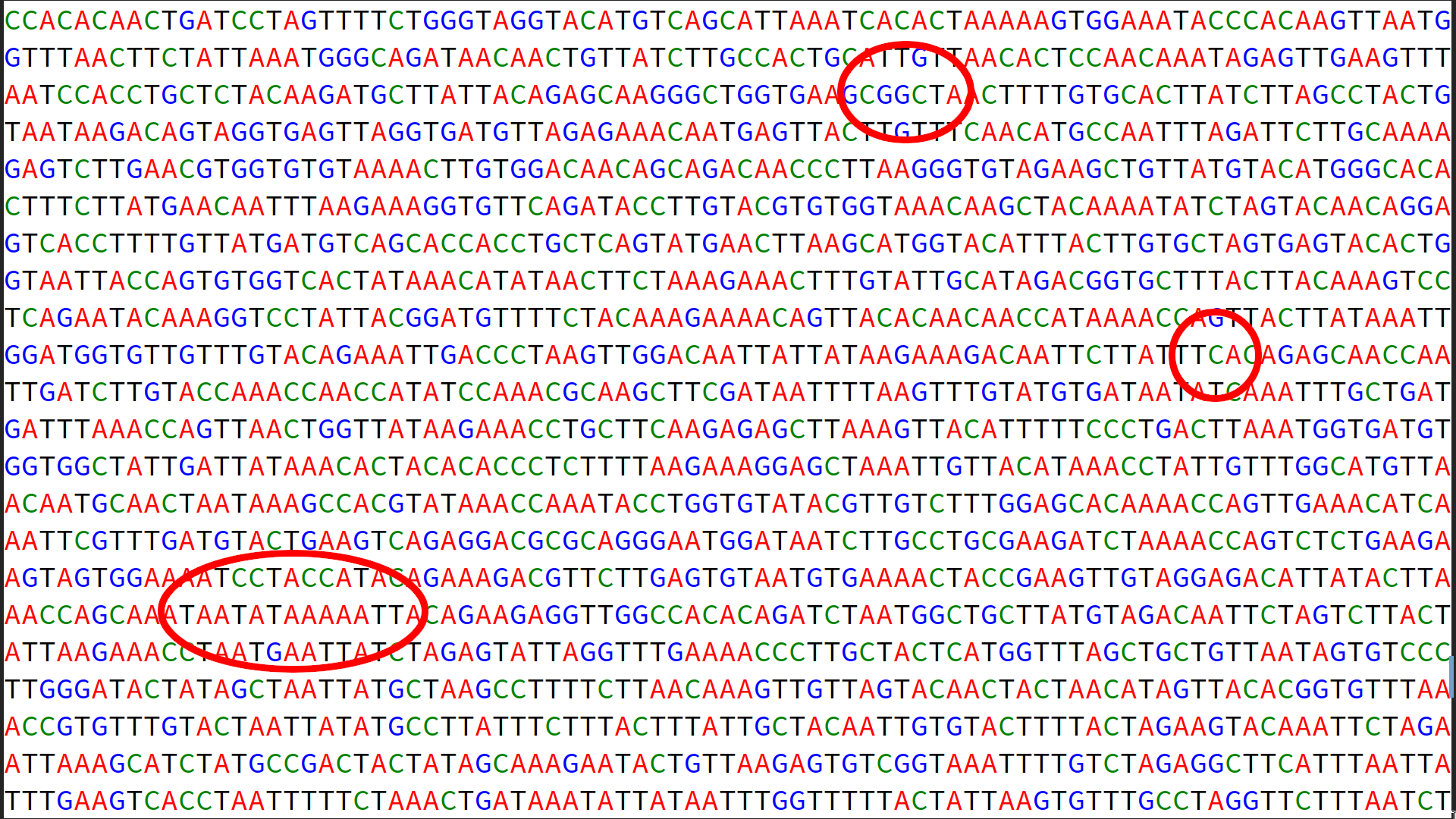
Pairwise alignment
- Find the mutations between two sequences
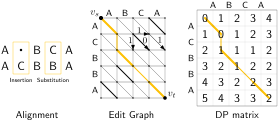
Dynamic programming
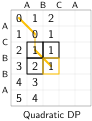
Dynamic programming
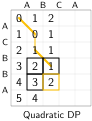
Dynamic programming
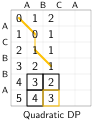
Dynamic programming
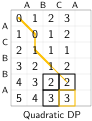
Dynamic programming
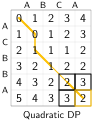
50 000 TB of sequenced DNA → it must be fast

Data Center
PhonlamaiPhoto | istockphoto.com
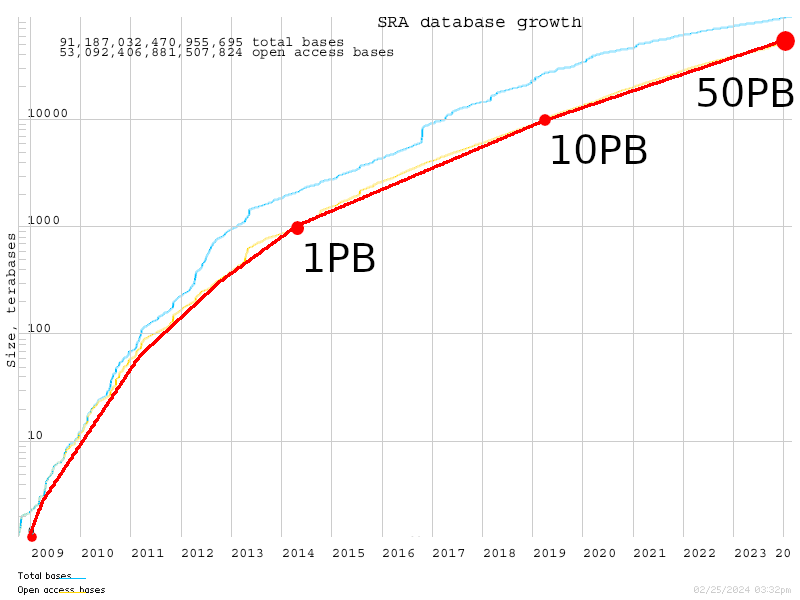
Growth of SRA
Goal:
Fast code
Goal:
High throughput code
Goal:
Optimal throughput code
What is high troughput code?
- Complexity
Few operations:
\(\quad O(n^2)\quad\longleftrightarrow\quad O(n)\)
- Efficiency
Fast operations:
memory read, 100 ns \(\quad\longleftrightarrow\quad\) 0.1 ns, addition
- Implementation
Parallel operations:
SIMD, instruction-level parallelism
Lots of work on this problem!
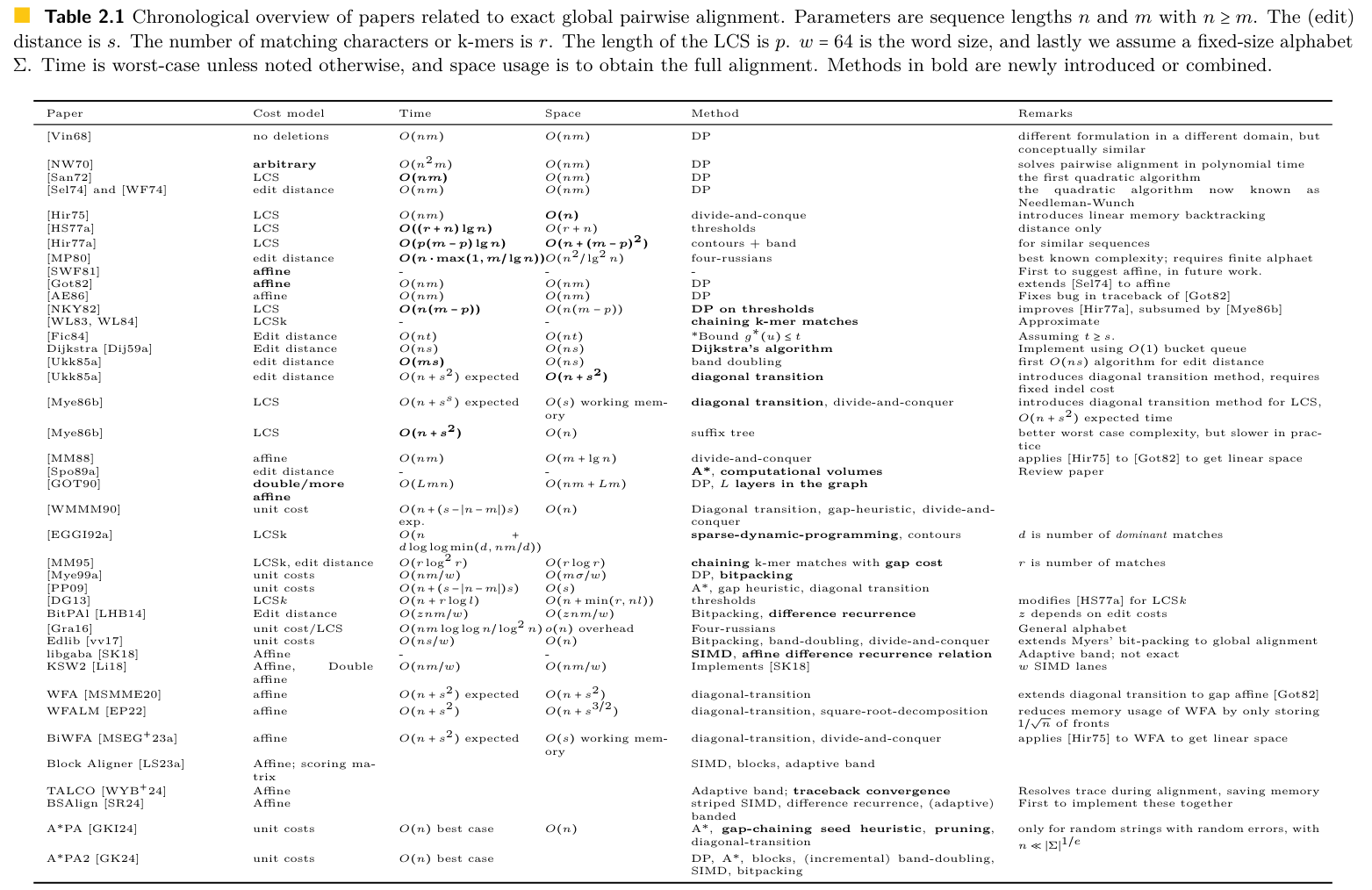
Needleman-Wunsch – Quadratic \(O(n^2)\)


Can we do better than quadratic?
No! (not much anyway)
- There is a \(O(n^{2-\varepsilon})\) lower bound assuming SETH.
- One of the best algorithms is four Russians in \(O(n^2 / \lg n)\):

Can we do better than quadratic? – take 2
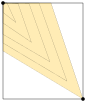
Yes! BFS / Dijkstra – \(O(ns)\) for distance \(s\)
- Visit only states at distance \(\leq s\), within the central \(2s+1\) diagonals.

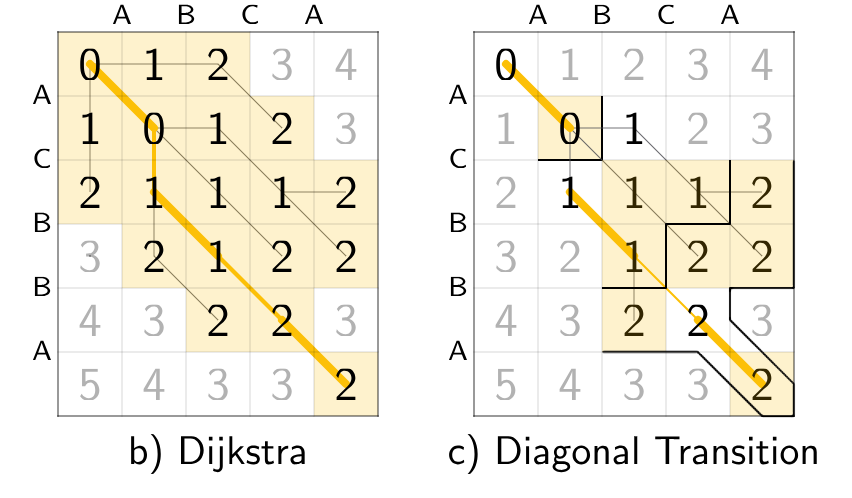
Diagonal transition – \(O(n + s^2)\)
- Greedily extend matches along diagonals → visit \({\leq} s\) states per diagonal
Diagonal transition – \(O(n + s^2)\)
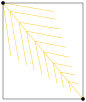

A*PA – near-linear, \(3\times\) faster on similar seqs


[1] Exact Global Alignment Using A* with Chaining Seed Heuristic and Match Pruning.
RGK and Pesho Ivanov, Bioinformatics 2024.
A*PA heuristics
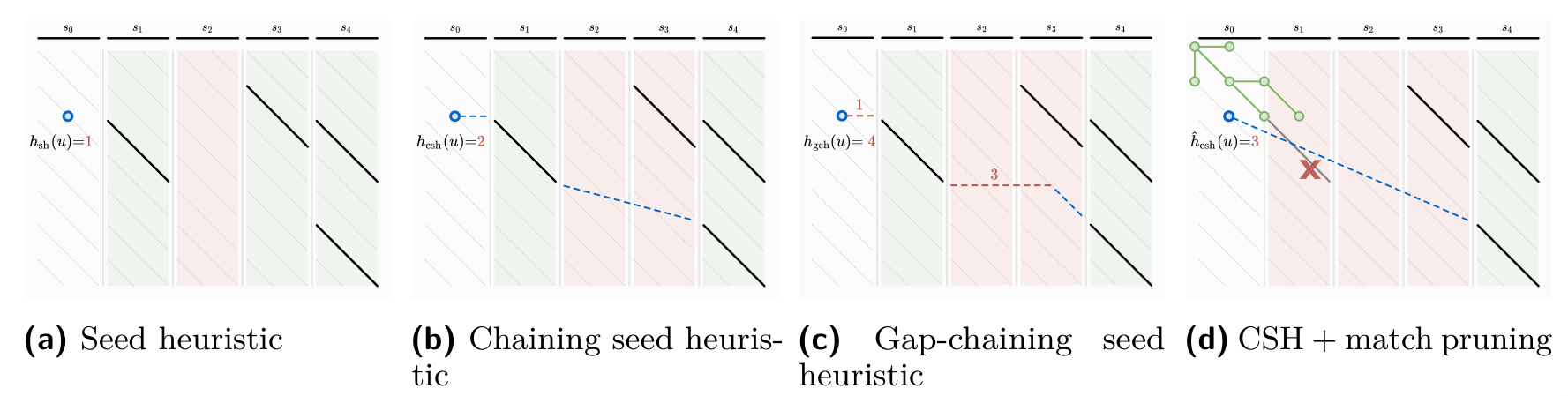
A*PA – not quite linear, and terrible efficiency

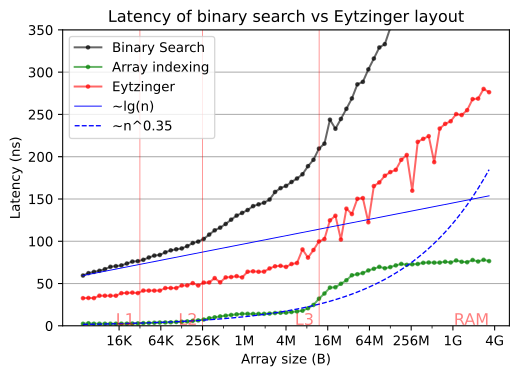
Intermezzo: array indexing is not \(O(1)\)!
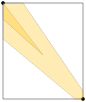
Band Doubling – \(O(ns)\)
- Compute all states within central \(t\) diagonals for exponentially growing \(t\). Super efficient!

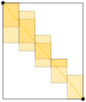
Optimizations
Bitpacking (Myers' 99)
- Computes \(w=64\) states at once by encoding the \(\{-1, 0, +1\}\) differences between adjacent states in a word.
- \(O(ns/w)\)
SIMD: single instruction multiple data, special CPU instructions.
- Operates on e.g. 4 or 8 64-bit words at the same time..
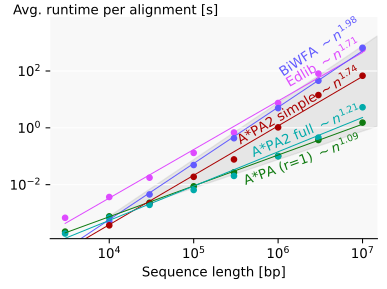
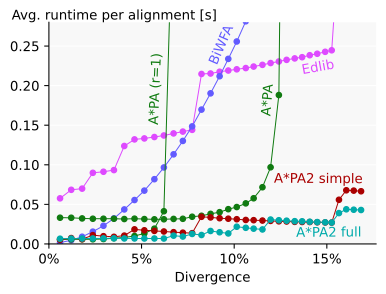
A*PA2 – good efficiency: up to \(19\times\) faster
- Band-doubling + bitpacking + SIMD + A*PA

[2] /A*PA2: Up to 19x Faster Exact Global Alignment. WABI 2024.
A*PA: comparison
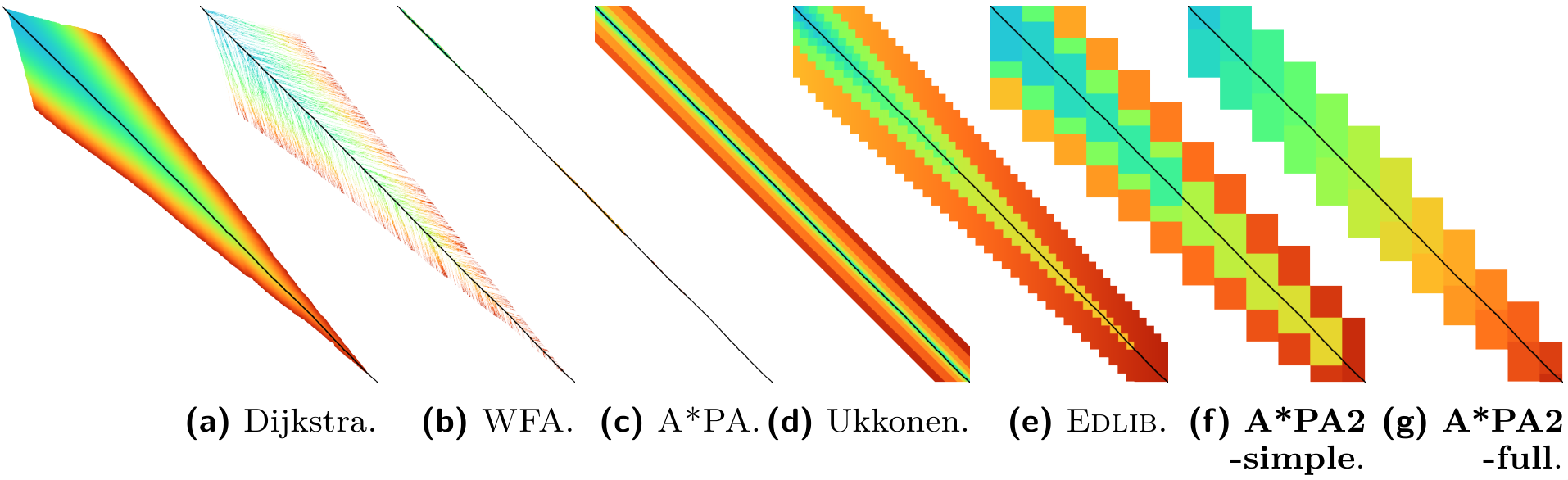
But: Long-read global alignment is just not a problem people have…
Alignment modes
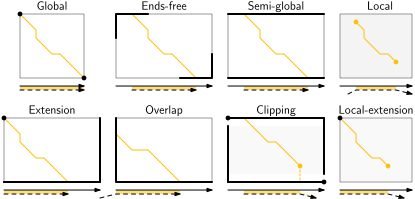
Semi-global variants
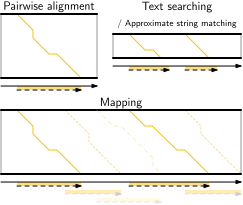
… Sassy: 100bp semi-global alignment
Approximate String Matching
- Find pattern \(P\) in text \(T\).
- \(m := |P|\), \(n := |T|\)
- Allow up to \(k\) unit-cost errors.
- Find all matches.
- IUPAC support: Handle
ACTG,N,YR...
- Not semi-global alignment
- Not \(\Theta(nm/w)\)
- Not new: Lots and LOTS of old literature
ASM in \(O(\lceil n/w\rceil k)\)
- Myers' bitpacking on \(w=64\)-bit blocks.
- "Early break" when all states in block have cost \(>k\), after \(\approx 2k\) rows.
- Horizontal tiling because \(k\ll w\) makes \(O(n \lceil k/w\rceil)\) inefficient.
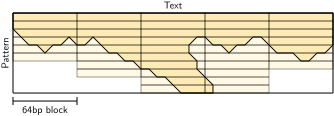
SIMD: Chunking the text
- Split the text in 4 chunks.
- Process 1 chunk per SIMD-lane.
- The blue blocks are all evaluated at the same time!

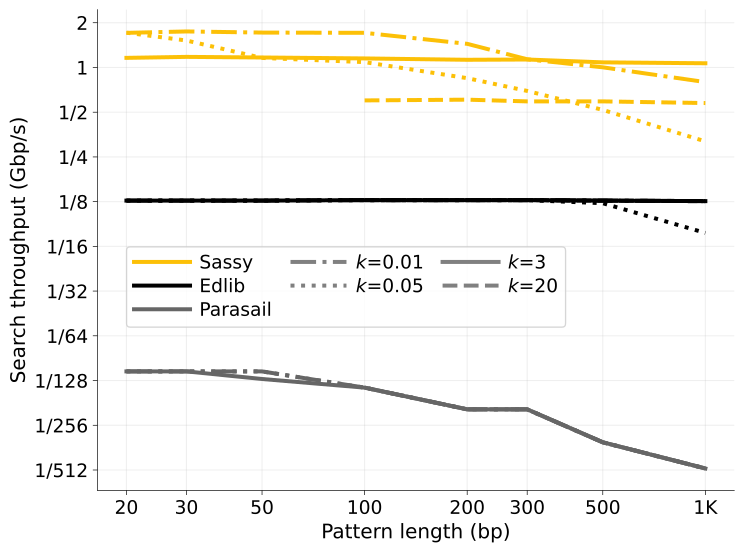
Sassy 1: search long text at \({>}1\) Gbp/s
- Params:
- \(20 \leq |P| \leq 1000\), \(n=10^5\)
- 1 thread, fwd search only
- Results:
- k=3: 1.1 Gbp/s
- k=20: 600 Mbp/s
- 10\(\times\) Edlib, 128\(\times\) parasail
Applications:
- Crispr off-target searching
- Many short patterns, fixed reference → Columba (Renders+ 2025)
- Barcode detection for demultiplexing
- Many short patterns, reads → Batching!
CLI: sassy grep -p <pattern> -k 3 <hg>.fa

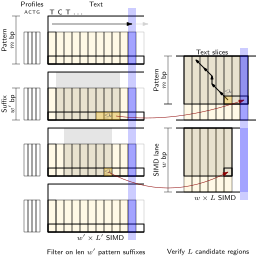
Sassy 2: batching \(\gg\) chunking
- Text chunking requires
gatheringand transposing - Take pattern suffix of len \(w'\in\{16,32\}\)
- Random DNA has edit distance \(\approx 45\%\).
- \(w'>2k+\varepsilon\) ensures few spurious matches.
- One suffix per SIMD lane.
- Post-process if suffix matches with cost \(\leq k\).
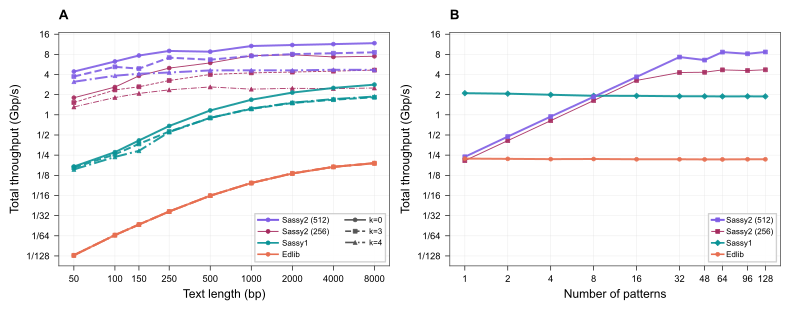
Sassy 2: search at 8 Gbp/s
- A: 128 patterns of len 23, 1 thread, \(k\in \{0,3,4\}\). B: \(n=10^5\), \(k=3\).
Sassy 2 Application: Crispr off-target & Barbell
- Search a 23bp guide RNA in a human genome with \(k=3\) in 30ms or amortized >100 Gbp/s on 16 threads.
- 3.7\(×\) Sassy1, 35\(×\) Edlib
- Scan Nanopore reads for 96 ONT rapid barcodes with \(k=3\) at 1.2 Gbp/s!
- 4.6\(×\) Sassy1, 45\(×\) Edlib
- Barbell (Beeloo+) is a fast & accurate demultiplexer using Sassy2.
- Poster tonight!
Outlook: Sassy-GPU
Extras
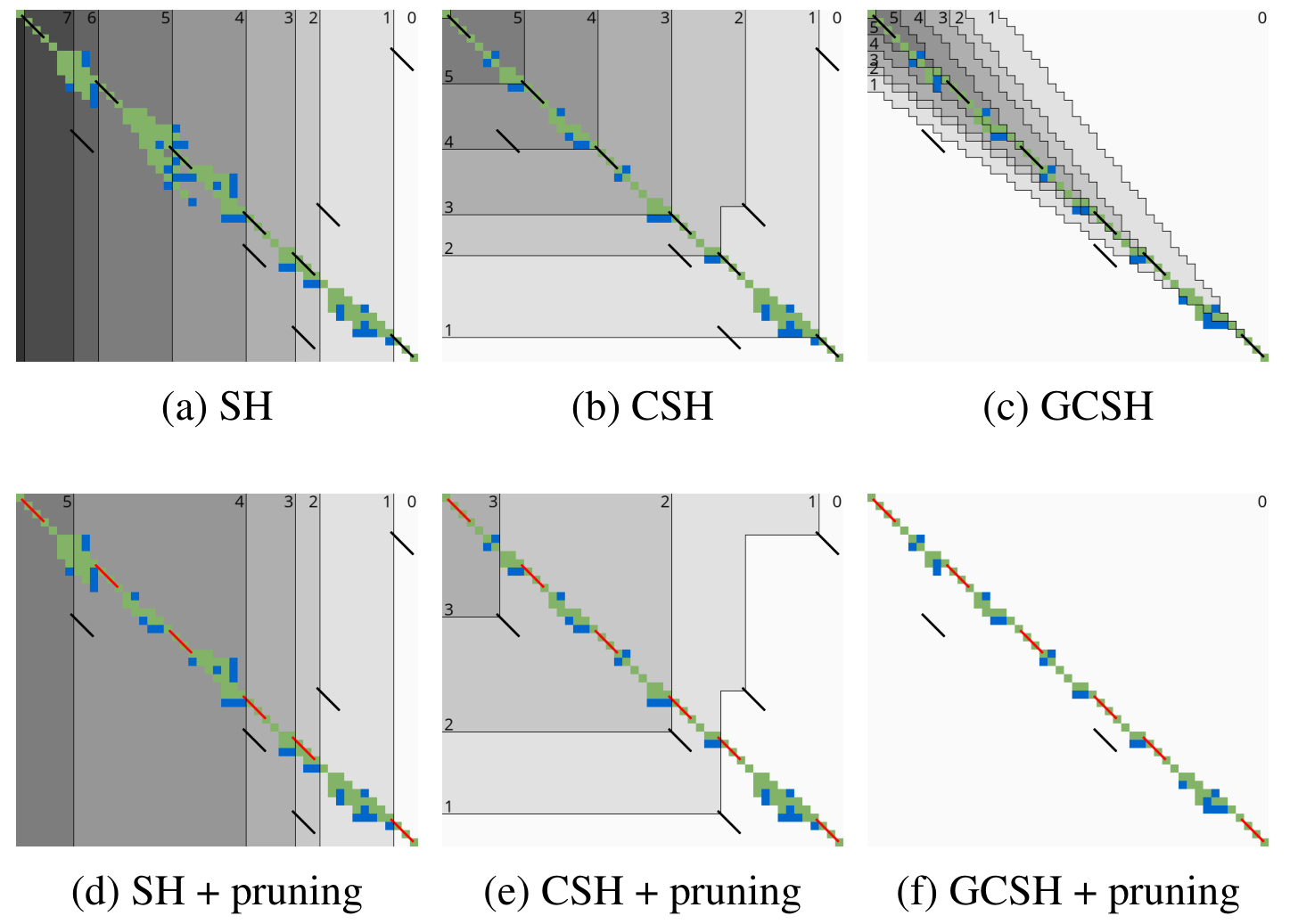
A*PA: seed heuristic
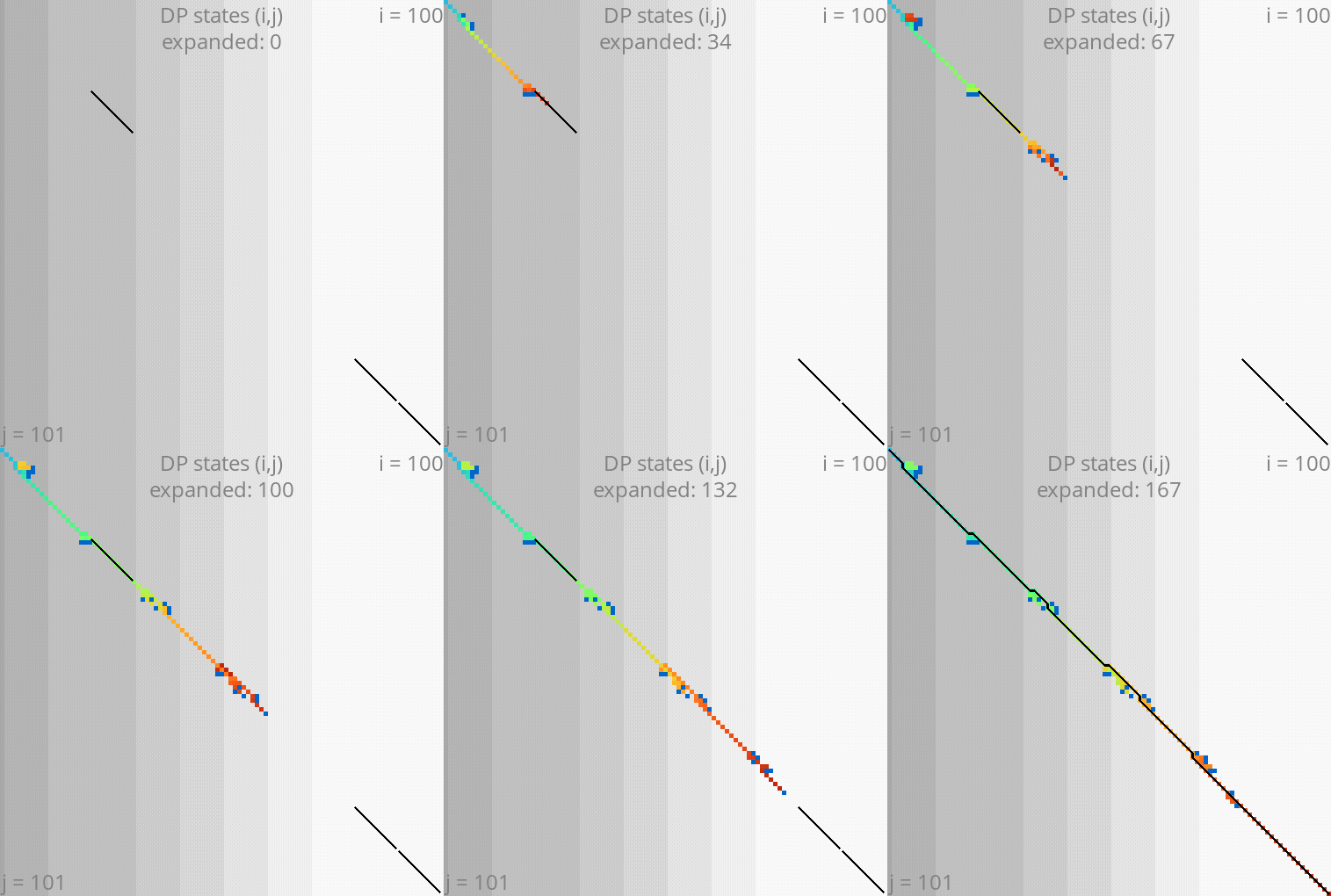
A*PA: gap-chaining seed heuristic
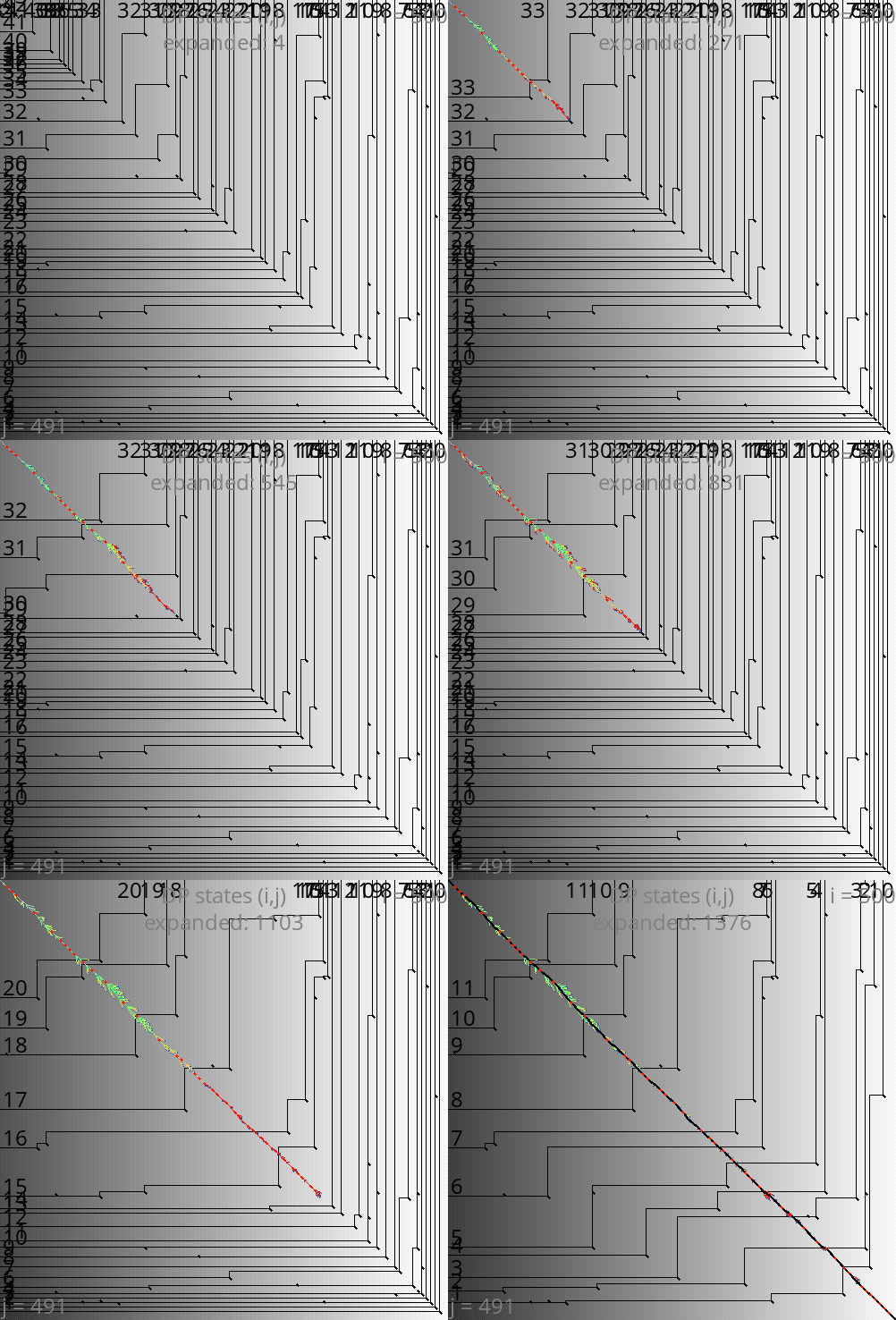
A*PA: contours
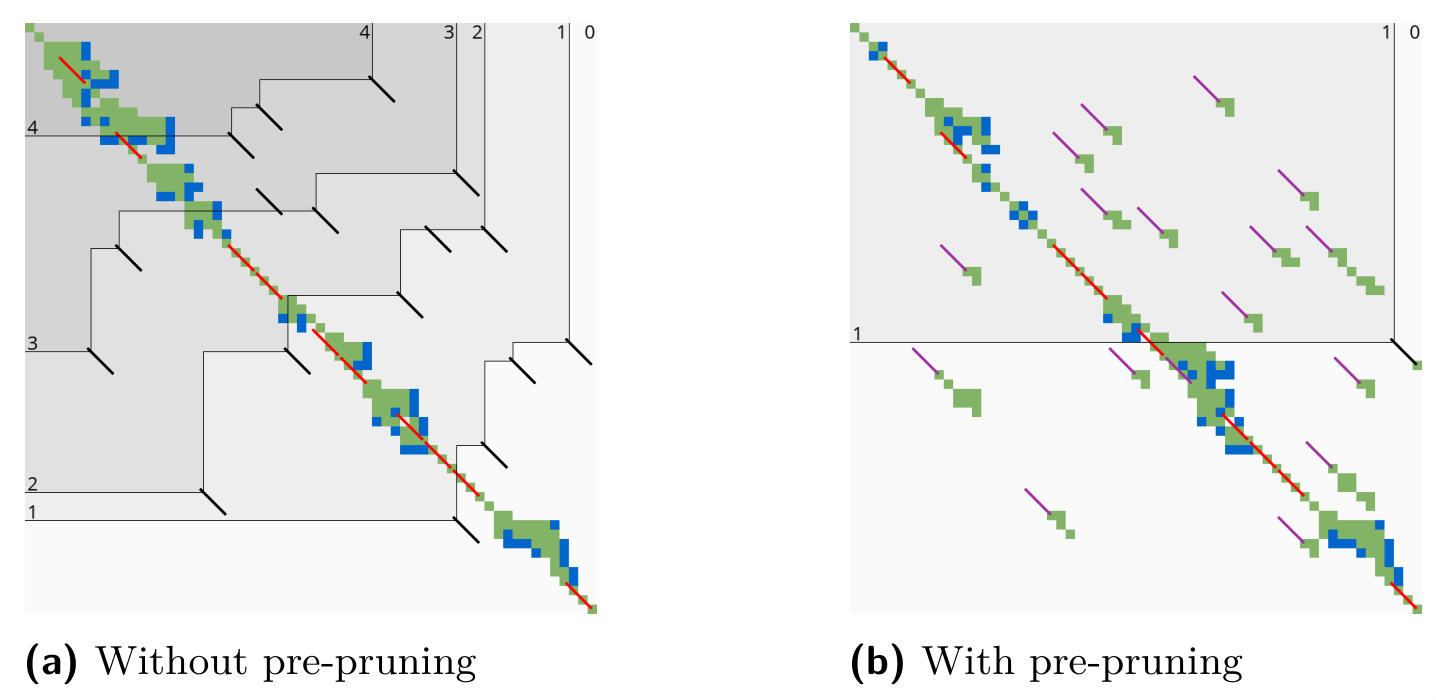
A*PA2: pre-pruning
A*PA2: results (real data)
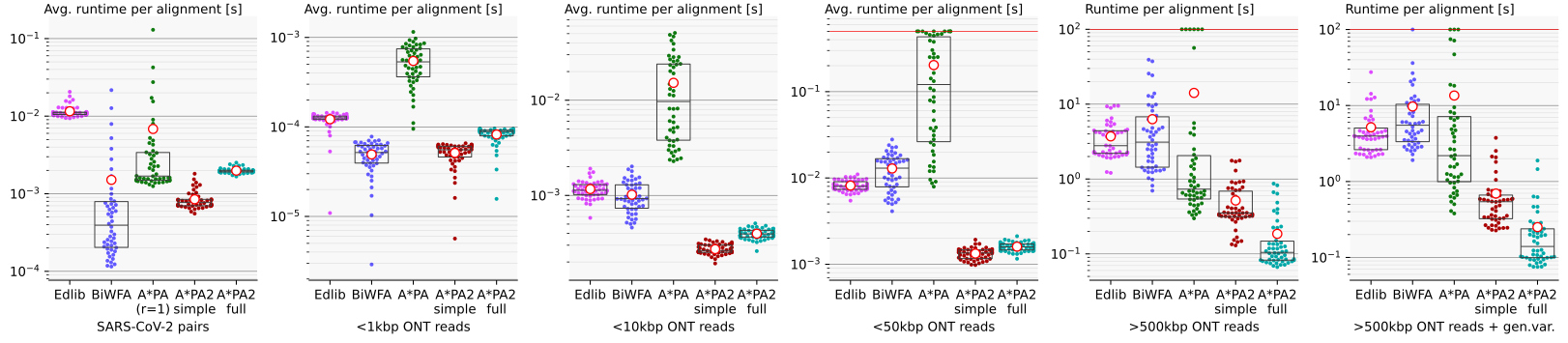
A*PA2: results (synthetic)