Elias-Fano coding
Advanced Data Structures – Summer 2026 – Lecture 2
Ragnar {Groot Koerkamp}, Stefan Walzer, Stefan Hermann
2026-04-27 Mon 14:00
curiouscoding.nl/teaching
Previous slides: Bit vectors, Rank & Select
- Bit vector: storing bits
- Rank: counting 1 bits
- Select: finding 1 bits
Goal: Storing lists of integers
How do we efficiently store a list of integers \[ 0\leq x_0 \leq x_1 \leq \dots \leq x_{n-1} < U. \]
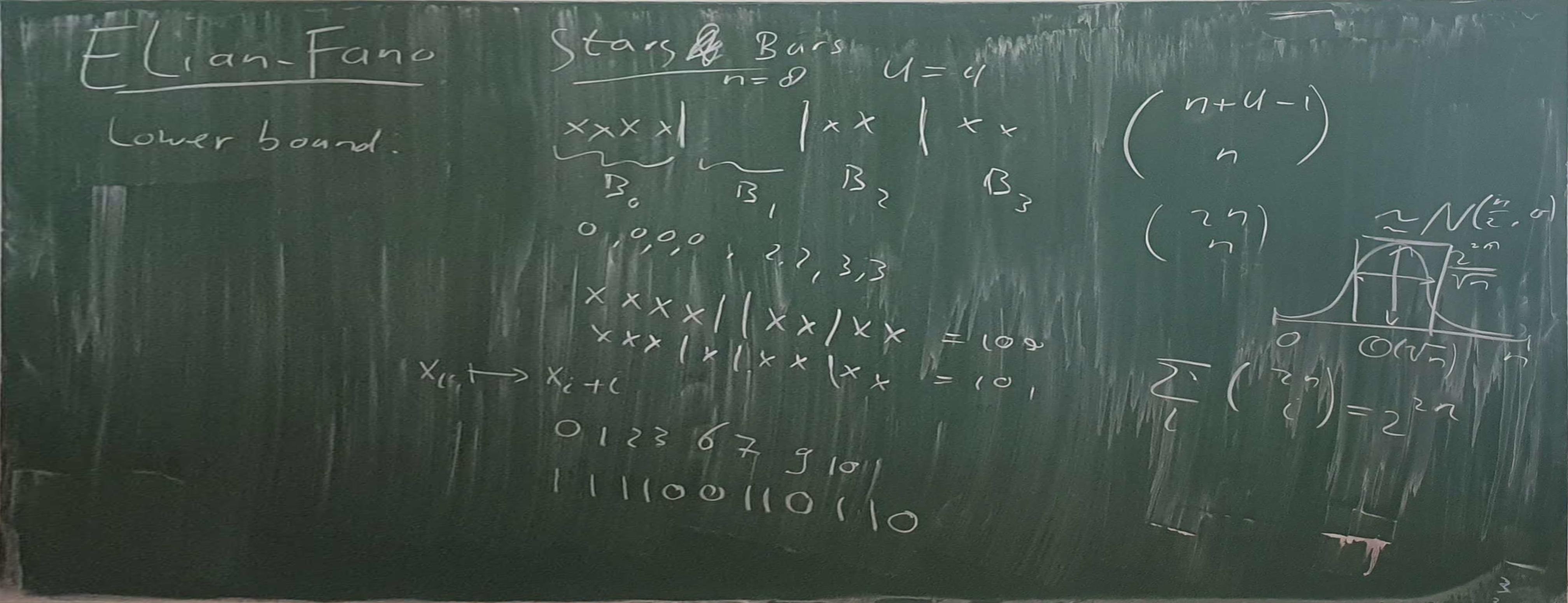
Using stars and bars, there are \(\binom{U+n-1}{n}\) of choosing \(n\) elements (with duplicates) from \(\{0, 1, \dots, U-1\}\).
\[ n \log_2 \left(\frac{U+n-1}{n}\right) \leq \log_2 \binom{U+n-1}{n} \leq n \log_2 \left(e\cdot \frac{U+n-1}{n}\right) \] so it can be done with \(\log_2 e + \log_2\left(\frac{U+n-1}{n}\right)\) bits per key.
For \(n = o(\sqrt U)\) and \(n\to\infty\), \[ \frac 1n \log_2 \binom{U+n-1}{n} \to \log_2 \left(e\cdot \frac{U}{n}\right). \]
Storing many small integers (\(n \gg U\))
What if \(n \gg U\)?
When \(n\gg U\), store how often each element occurs.
- \(U \log_2 n\) bits
Storing dense lists (\(n\approx U\))
What if \(n \approx U\)?
(Hint: What if all elements are distinct?)
When all elements are distinct: store \(U\) bits indicating for each \(1\) or \(0\).
- \(U\) bits
Otherwise: encode all the counts in unary and concatenate them, e.g., a count of 3 becomes 1110.
- \(U + n\) bits
- Lower bound for \(n=u\): \[\log_2\binom{U+n-1}{n} = \log_2\binom{2n-1}n = \log_2\big(\Theta(2^{2n}/\sqrt n)\big) \approx 2n\]
Storing sparse lists (\(n\ll U\))
What if \(n \ll U\)?
Store directly:
- \(n \log_2 U\) bits.
- Lower bound for \(n\ll U\): \(n\log_2\left(e\cdot \frac Un\right) = n\log_2(eU/n)
= n(\log_2 U + \log_2 e -
\log_2 n)\)
- \(\log_2 n - \log_2 e\) bits/key wasted!
Where is the "waste"/inefficiency?
Consecutive elements share the \(\approx \log_2 n\) high bits!
Elias-Fano coding (Elias 1974; Fano 1971; Vigna 2013)
A list of \(n\) integers \(0\leq x_0\leq x_1\leq \dots \leq x_{n-1} < U\) can be stored in \[ n (\log_2 (U/n) +2) \] bits while supporting \(O(1)\) access time using an additional \(o(2n)\) bits for select operations.
This is only \(2-\log_2(e) = 0.5573\) bits/key away from the lower bound when \(n = o(\sqrt U)\)!
Idea:
- We have budget to store the \(\ell = \lfloor \log(U/n)\rfloor\) bits explicitly.
- But how do we encode all \(\log U - \ell \approx \log n\) high bits using \(\approx 2\) bits/key?
- Using the \(n\approx U\) case!
Elias-Fano coding
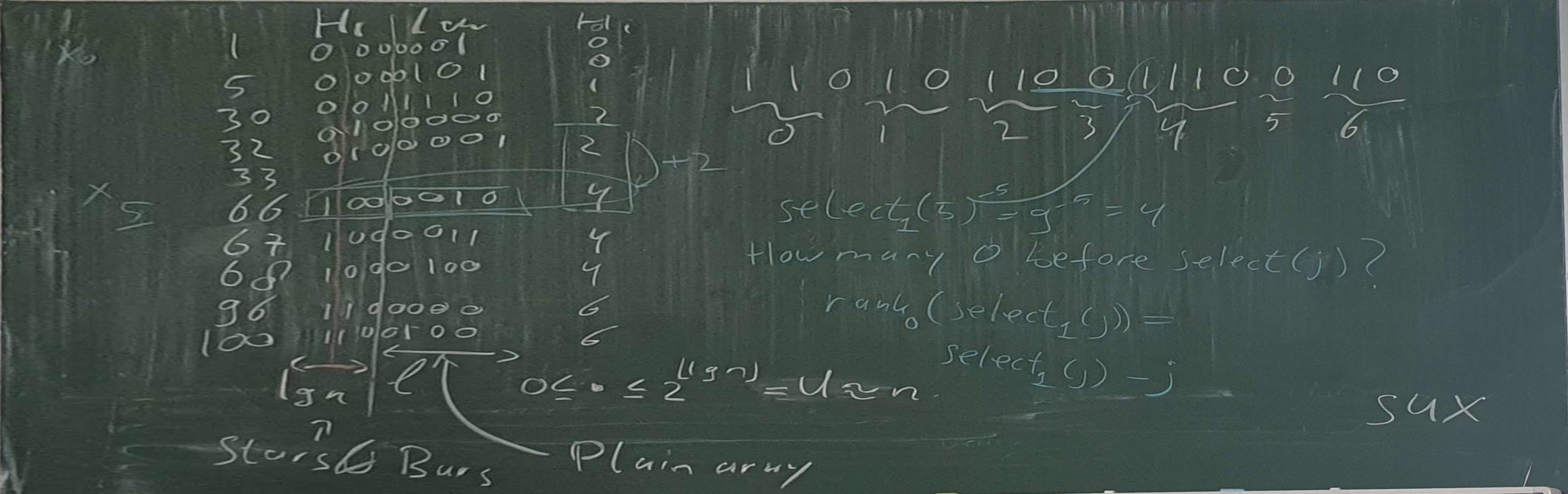
Split each integer into a \(\ell=\lfloor \log(U/n)\rfloor\)-bit low part and \((\log U - \ell)\)-bit high part.
- Store all low bits explicitly in \(n \ell\) bits.
- Write how often each high part occurs in unary.
- \(\lceil U/2^\ell\rceil\) high parts with \[n \leq \lceil U/2^\ell \rceil < 2n.\]
- In total \(n + \lceil U/2^\ell\rceil \leq 3n\) bits.
- Thus, space usage below \[n \ell + 3n = n(\lfloor \log (U/n)\rfloor+3)\]
- More refined analysis shows that actually: \[n\lfloor \log(U/n)\rfloor + n + \lceil U/2^\ell\rceil \leq n (\log (U/n)+2).\]
Interpretations of the high-bit encoding
- Each input number corresponds to a 1.
- Each "bucket" for the high parts corresponds to a 0.
- 0 separates the unary count in number of 1 for each high part.
- The number of 0 directly before a 1 is the jump the high part makes from the previous value.
- The total number of 0s before a 1 is the value of the high part.
Querying Elias-Fano
To get \(x_i\):
- Read the \(i\)'th group of \(\ell\) low bits.
Get the high part of the \(i\)'th value:
- Count zeros before the \(i\)'th 1 (counting from 0):
\[\mathsf{high}(i) = \mathsf{select}_1(i) - i\]
Variants
- As discussed: storing sorted lists of integers.
- For strictly increasing integers: replace \(x_i\) by \(x_i-i\).
- To store a non-sorted list with small sum: store prefix sums.
Further reading / sources
- Giulio Pibiri's notes on Elias-Fano
- Modern paper reviving/applying it: (Vigna 2013)
- Original papers: (Elias 1974; Fano 1971)
- Dynamic version: (Pibiri and Venturini 2017)
sux::EliasFanoimplementation
Bibliography
Possible exam questions
- What is the core idea of Elias-Fano coding?
- What is the stars & bars technique? Relate it to a binomial coefficient.
- How may "high" bits are there? Why does this make sense?
- What is the space of the Elias-Fano encoding? Is it far from the lower bound?
- What are some interpretations of the bits encoding the high parts?
- How does one recover \(x_i\), i.e., query the Elias-Fano coded list?
Blackboard: Elias-Fano 1
Blackboard: Elias-Fano 2