Succinct trees
Advanced Data Structures – Summer 2026 – Lecture 3
Ragnar {Groot Koerkamp}, Stefan Walzer, Stefan Hermann
2026-05-04 Mon 14:00
curiouscoding.nl/teaching
Previous slides: Rank & Select, Elias-Fano
- Rank: counting 1 bits
- 2 levels of blocks of length \(\log^2 n\) and \(\log n\)
- Select: finding 1 bits
- 2 levels of blocks with \(\log^2 n\) 1-bits and \(\sqrt{\log n}\) 1-bits.
- There exist succinct \(o(n)\) space data structures for rank and select.
- Elias-Fano: efficient encoding of sorted list of integers
- Split in high and \(\ell\)-bit low part; \(\approx 0.5\) bit/elem overhead.
- Encode high parts using stars & bars:
1 for each element, 0 each time a multiple of \(2^\ell\) is crossed.
Today: Succinct representation of trees
A.k.a.: applications of rank and select.
- What is a tree?
- How many trees on \(n\) nodes are there?
- How do we encode the tree?
- 3 options: LOUDS (BFS),
- balanced parentheses (in-order DFS),
- DFUDS (pre-order DFS)
- Operations on trees
- degree, parent, \(i\)'th child, subtree size
Application: in-place json parsing
Ordered trees
An ordered tree is a tree with:
- \(n\) nodes, \(n-1\) edges,
- a single root,
- an order on the children of each node.
How many ordered trees are there at least? At most?
Bijection to balanced parentheses
There is a bijection between ordered trees on \(n\) nodes and balanced parentheses (BP) sequences of \(n-1\) "(" and ")", where each "(" has a matching ")".
"Trace" the outline of the tree in DFS-order: each time an edge goes down, write "(", and each time an edge goes up, write ")".
Upper bound
There are \(o(4^n)\) ordered trees on \(n\) nodes.
The number of BP sequences is at most
\[\textsf{#trees} \leq \binom{2(n-1)}{n-1} = \Theta\left(\frac{2^{2n}}{\sqrt n}\right).\]
Or simpler: each of the \(2(n-1)\) positions is ( or ), giving \(\leq
2^{2(n-1)}< 4^n\).
Lower bound
There are \(\Omega(4^n/n^{1.5})\) ordered trees on \(n\) nodes.
Partition the \(\binom{2(n-1)}{n-1}\) possible BP sequences in equivalence classes under rotation of the string. Take a random element of any class. Find the prefix with the largest value of \(\mathsf{count}_)(i) - \mathsf{count}_((i)\), and consider the rotation starting after this prefix. This is a BP. Thus, each class has size \(\leq 2(n-1)\), and contains at least one BP:
\[\textsf{#trees} \geq \frac 1{2(n-1)}\binom{2(n-1)}{n-1} = \Omega\left(\frac{2^{2n}}{n^{1.5}}\right).\]
Space lower bound
We need at least \[\frac 1n\log_2(4^n/n^{1.5}) = 2 - o(1)\] bits per node, and this is tight.
Represent trees using \(2 + o(1)\) bits per node, while supporting common operations.
Aside: Catalan numbers
The exact number of ordered trees on \(n\) nodes is the Catalan number: \[ C_{n-1} := \frac1{n} \binom{2(n-1)}{n-1} \sim \frac{4^{n-1}}{n^{3/2} \sqrt \pi}. \]
Aside: Bijection to binary trees
- Bijection between ordered trees and binary trees.
- Given a binary tree, transform it to an ordered tree like this:
- a left child of a node is a child in the ordered tree.
- a right child of a node is a sibling in the ordered tree.
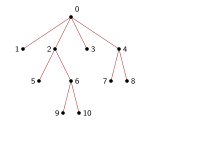
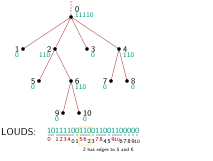
Level Ordered Unary Degree Sequence (LOUDS)
Start with 10.
Then append the degree of each node in level/BFS order in unary:
1 for each child, and then a 0.
10111100110011001100000
0_123401562378459067890
- 1: introduce node as child.
- 0: end the list of children of the node.
\(2n+1\) bits:
- a 1 to add the node as child,
- an 'end' marker 0 for each node,
- an extra 0.
Operations
How to implement operations:
- degree,
- \(i\)'th child,
- parent,
- subtree size.
10111100110011001100000
0_123401562378459067890
\[ \newcommand{\rank}{\mathsf{rank}} \newcommand{\select}{\mathsf{select}} \]
Implementing the operations
10111100110011001100000
0_123401562378459067890
Number nodes \(0\) to \(n-1\) in level/BFS-order.
- Position of 0 of \(u\): \(p_0(u):=\select_0(u+1)\)
- Position of 1 of \(u\): \(p_1(u):=\select_1(u)\)
- Children of \(u\): position \(\select_0(u)+1\) to \(\select_0(u+1)\)
- Degree of \(u\): \(\select_0(u+1) - \select_0(u) - 1\).
- \(i\)'th child of \(u\): (number of children before \(u) + i = \rank_1(\select_0(u)) + 1 + i\)
- Parent of \(u\): the node containing the \(u\)'th 1: \(\rank_0(\select_1(u))-1\)
- Roughly inverse of \(\mathsf{child}\)
- Subtree size: hard; data is all over the place
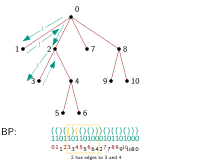
Balanced Parentheses (BP)
Traverse tree in DFS-order.
Write a ( each time a node/subtree is first entered, and a ) a node/subtree
is left.
(()(()(()()))()(()()))
1101101101000101101000 10 instead of ()
0112334556642778990080
- 1: enter subtree
- 0: leave subtree
\(2n\) bits: a ( and ) for each node.
Note: the children of a are all over the place!
\(\rank\) and \(\select\) won't work here.
Additional operations on BP
- \(\mathsf{findclose(i)}\): given
(at pos \(i\), get the position of the matching). - \(\mathsf{findopen(i)}\): given
)at pos \(i\), get the position of the matching(. - \(\mathsf{enclose(i)}\): given
(at pos \(i\), get the position of the closest(left of it enclosing it.
Can all be done in \(O(1)\) time and \(o(n)\) space
Implementation: See Navarro and Sadakane (2014)
Implementing findclose and enclose
- Uses a segment tree (next week) over \(\mathsf{excess}(i) = \rank_((i) - \rank_)(i)\).
- matches depth in the tree
- \(\mathsf{findclose}(i) = \min\{j > i: \mathsf{excess}(j)=\mathsf{excess}(i-1)\}\)
- \(\mathsf{findopen}(i) = \max\{j < i: \mathsf{excess}(i)=\mathsf{excess}(j-1)\}\)
- \(\mathsf{enclose}(i) = \max\{j < i: \mathsf{excess}(i)=\mathsf{excess}(j-1)+2\}\)
- Each node of the segment tree stores the difference of ( and ) over its range, and the minimum depth node it contains.
- Further details omitted.
Implementing the BP operations
(()(()(()()))()(()()))
1101101101000101101000 10 instead of ()
0112334556642778990080
Number nodes \(0\) to \(n-1\) in DFS-order.
- Position of ( of \(u\): \(p=\select_((u)\)
- Subtree size of \(u\): \((\mathsf{findclose}(p) - p + 1)/2\)
- Parent of \(u\): \(\mathsf{enclose}(p)\)
- Degree, \(i\)'th child: hard (Navarro and Sadakane 2014)
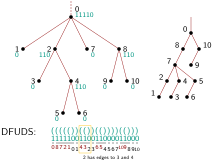
Depth-First Unary Degree Sequence (DFUDS)
Start with 1.
Then traverse the nodes in DFS order, and append for each its degree in unary:
a 1 for each child and then a 0.
Then convert 1 to ( and 0 to ) to get a BP sequence.
((((())(())(())))(()))
1111100110011000011000
0872101432365456790890
- 1: introduce node as child.
- 0: end the list of children of the node.
\(2n\) bits: 1 to introduce each node,
0 to end the unary degree encoding of each node.
Implementing the DFUDS operations
((((())(())(())))(()))
1111100110011000011000
0872101432365456790890
- Start position of \(u\): \(\select_0(u-1)+1\). (Edge case \(u=0\).)
- End position of 0 or ) of \(u\): \(q=\select_0(u)\)
- Degree of \(u\): \(\select_0(u) - \select_0(u-1) - 1\). (Edge case \(u=0\).)
- Start position of \(i\)'th child: position after the matching
): \(\mathsf{findclose}(q-1-i)+1\) - Parent of \(u\): inverse of child: get preceding ), then matching (, then succeeding ): \(\select_0(\rank_0(\mathsf{findopen}(\select_0(u-1))))\)
- Subtree size of \(u\), starting at first bit \(p\): find succeeding
)that leaves the subtree: \((\mathsf{findclose}(\mathsf{enclose}(p)) - p)/2 + 1\)
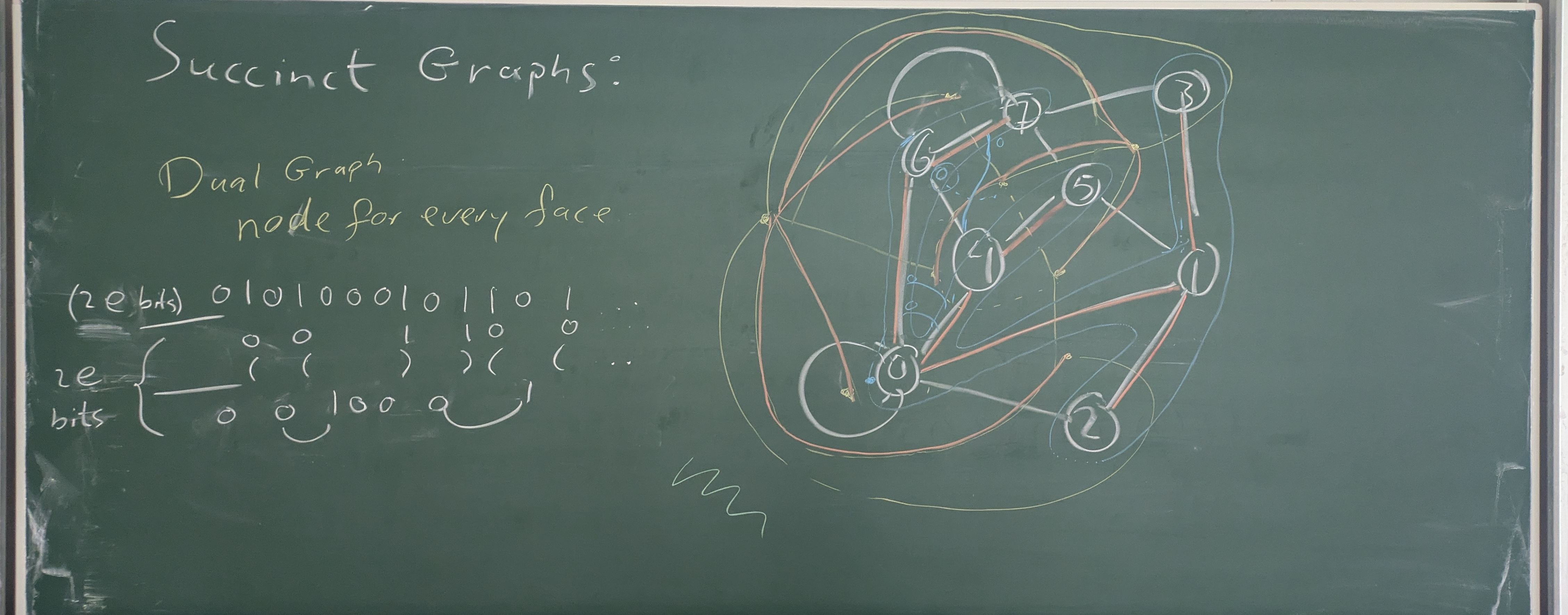
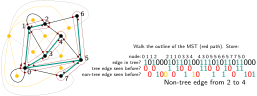
Compact planar graphs

- Euler's formula: \(v - e + f = 2\),
i.e. \(e = (v-1) + (f-1)\) - Two spanning trees
- one of nodes
- one of faces
- DFS-Traverse the spanning tree \(T\) (red)
- Start on outer face.
- In each node go clockwise.
- Data:
- For each edge we see, whether is in \(T\)
- For each \(T\)-edge, whether we saw it before
- For each non-\(T\) edge, whether we saw it before
- (Turán 1984; Ferres et al. 2020)
Compact planar graphs
Further reading / sources
- Florian Kurpicz' slides from 2024
- Wikipedia on Catalan numbers
- Wikipedia on binary trees
- Wikipedia on binary tree equivalence
- Paper on succinct trees: Navarro, Gonzalo, and Kunihiko Sadakane. 2014. “Fully Functional Static and Dynamic Succinct Trees.” Acm Transactions on Algorithms 10 (3): 1–39. https://doi.org/10.1145/2601073.
Bibliography
Possible exam questions
- How many bit are needed to succinctly encode an ordered tree?
- Why is this sufficient?
- Why is this required?
- What are three different ways to succinctly encode an ordered tree?
- How do they relate?
- How do they differ?
- Which operations are (not) easily supported by each variant?
- Why is it hard to support both 'subtree size' and '\(i\)'th child' queries at the same time?
- In the LOUDS or DFUDS order, how does one get the degree of a node?
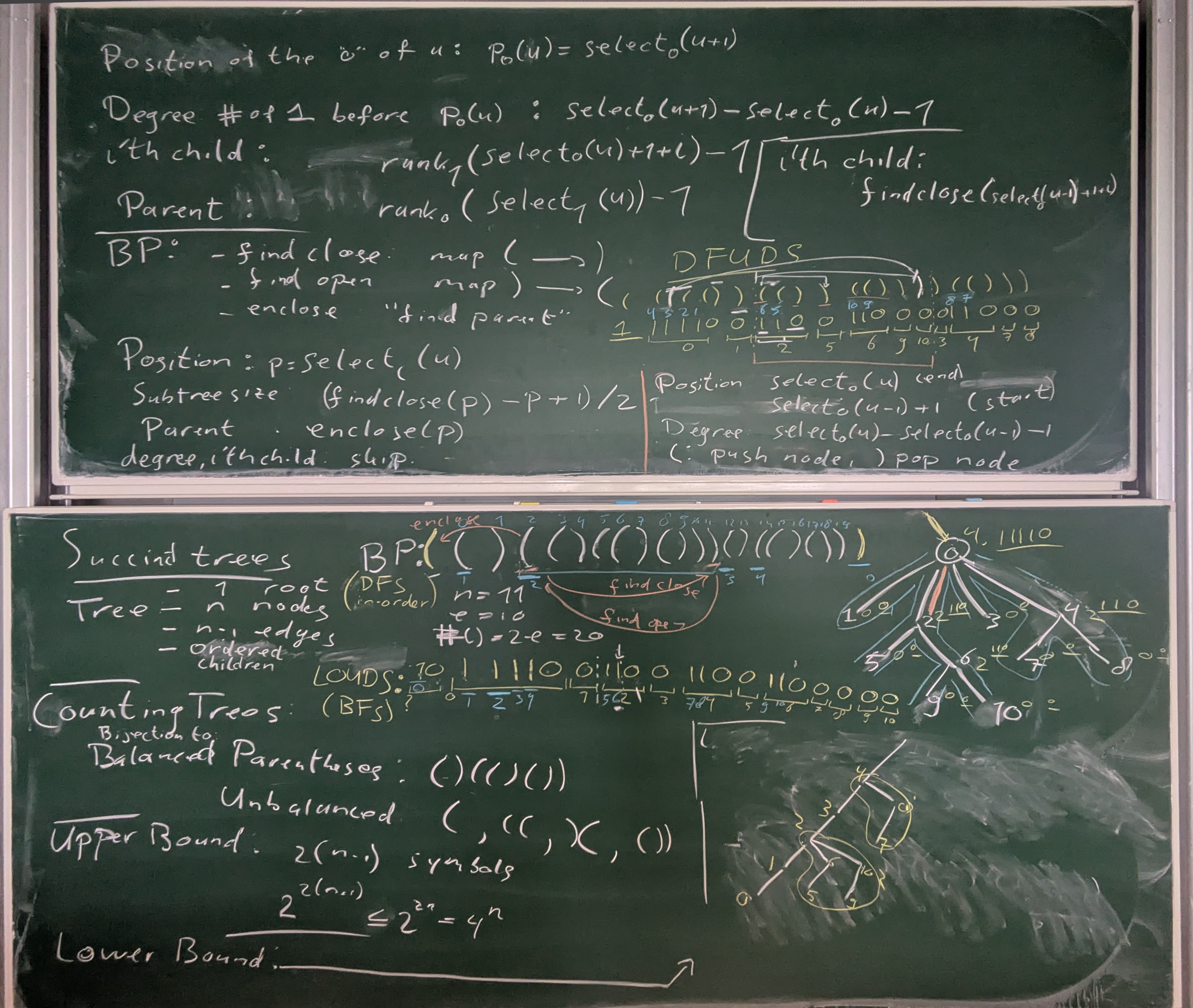
Blackboard: Succinct Trees
Blackboard: Succinct Graphs